


After an Indiana car or truck crash, whether an injury claim succeeds usually depends on evidence and deadlines, not just on who was at fault. The nine steps below cover what to preserve, what to avoid saying, and the Indiana deadlines that apply: two years to file most injury lawsuits, but only 180 days to give written notice if a city or county is involved.
Indiana police reported 200,035 traffic crashes in 2024. Those crashes killed 872 people and injured another 44,033, according to the state’s official crash data (Indiana Crash Facts 2024, Indiana University Public Policy Institute).
Most people who were hurt in those crashes never planned to file a lawsuit. Many of them later wished they had done a few things differently in the first days and weeks.
Whether your claim succeeds often depends less on what happened in the crash and more on what can be proven about it later. Evidence disappears. Deadlines pass. Insurers build their version of events early. Here is what you can do to protect your rights if you decide to pursue a claim against the driver who caused your crash.
The short version
- Call the police and get the crash report.
- Get medical care right away, even if you feel fine.
- Follow through on treatment and keep every bill.
- Photograph everything and collect witness information.
- Before you let your car be repaired, released, or scrapped, talk with an attorney about saving the vehicle’s black box data.
- If a truck was involved, act fast. Trucking records have short shelf lives.
- Be careful what you say to insurers, at the scene, and online.
- Check your own uninsured and underinsured motorist coverage.
- Know your deadlines, especially if a government vehicle or road was involved.
1. Call the police, even if the other driver asks you not to
The official crash report is often the first document an insurance adjuster reads. Indiana’s standard officer crash report records more than 200 pieces of information about each collision, including the location, the vehicles, the conditions, and what happened before impact (Indiana Crash Facts 2024).
There’s another reason to call. Hit-and-run was the most common crash circumstance in Indiana every year from 2020 through 2024. In 2024 there were 26,804 hit-and-run crashes, about 13% of all crashes, or more than one in eight (Indiana Crash Facts 2024). If the other driver leaves, a police report made at the time is critical to an uninsured motorist claim with your own insurer.
2. Get checked out, even if you feel fine
Adrenaline masks pain, and many crash injuries take hours or days to show up. In one clinical study summarized in a medical review, neck pain appeared in 65% of patients within six hours of injury, 93% within 24 hours, and 100% within 72 hours (Whiplash Injuries: A Systemic Review, Acta Scientific Neurology). That three-day window is one reason we wrote a separate guide on what to do within the first 72 hours of a car crash.
These injuries don’t always go away quickly. In a multi-center study of emergency room patients, 28% of those who were not pursuing any claim still had moderate or severe neck pain six weeks after their crash (McLean et al., PAIN, 2014). That matters because insurers sometimes suggest that lingering pain is exaggerated for a lawsuit.
A gap between the crash and your first medical visit is one of the most common arguments insurers use to reduce a claim. The simplest way to take that argument away is to be evaluated promptly.
Tell your provider about every symptom. Headaches, reduced neck movement, and low back pain are among the most commonly reported symptoms after whiplash-type injuries (Journal of Rheumatology, 2010). If a symptom isn’t in your medical record, it’s much harder to prove later.
3. Follow your treatment plan and keep every bill
Missed appointments and stopped treatment look, to an insurer, like an injury that wasn’t serious.
Keep every medical bill and every explanation of benefits (EOB) from your health insurer. In Indiana, what you can recover for medical care is its reasonable value, and a jury may hear both the amount a provider billed and the reduced amount the provider accepted as full payment. That is true whether the payer was a private health insurer (Stanley v. Walker, 906 N.E.2d 852 (Ind. 2009)) or a government health program (Patchett v. Lee, 60 N.E.3d 1025 (Ind. 2016)). Your lawyer will need the complete paper trail.
For the kinds of losses beyond medical bills, see our post on 7 hidden damages you can claim after a car crash in Indiana.
4. Document the scene and the people
If you’re physically able, take photos and video of the vehicles, the road, skid marks, debris, traffic signals, weather, and your injuries. Get names and phone numbers of witnesses. Note any nearby businesses or homes that might have security cameras, because that footage is often recorded over within days or weeks.
5. Don’t let your car disappear before its data is saved
Nearly every modern car has an event data recorder, often called a “black box.” The National Highway Traffic Safety Administration estimates that 99.5% of model year 2021 passenger vehicles have one (NHTSA final rule, December 2024). Five things are worth knowing about it:
- The data belongs to you. Under the federal Driver Privacy Act of 2015, crash data belongs to the vehicle’s owner or lessee. Anyone else generally needs your consent or a court order to retrieve it. Indiana has no black box statute of its own, so the federal rule controls here.
- It’s a short snapshot, not a surveillance tape. Federal standards call for about five seconds of information before impact: speed, braking, throttle, seat belt use, and how severe the impact was (49 C.F.R. Part 563). It does not record your location, audio, or video.
- Reading it is not a do-it-yourself job. A parts-store code scanner can’t read it. It takes manufacturer-licensed equipment, and the copy should be made by a trained, independent technician, ideally with the other side invited to attend, so nobody can later claim the data was mishandled. A download typically runs several hundred dollars per vehicle. Arranging it is your lawyer’s job, not yours.
- The data usually survives. The car often doesn’t. If the airbags deployed, federal rules require the record to be locked so it can’t be overwritten, and disconnecting the battery won’t erase it. What gets lost is the vehicle. Once an insurer declares a total loss, the car typically goes to a salvage auction, and ownership of the data goes with the title. Before you authorize repairs, release the car, or sign over the title, talk to a lawyer and ask your insurer in writing to hold the vehicle. If the airbags did not deploy, a later hard jolt can replace the record, so don’t keep driving the car until the data has been copied.
- The other driver’s data takes a letter or a court order. You have no right to it just by asking. A prompt written demand to the other driver and their insurer to preserve the vehicle untouched is what makes later destruction of that evidence costly for them.
6. Truck crashes: the clock runs faster
Trucking companies are required to keep certain records, but not for long. Under federal rules, carriers need to keep drivers’ hours-of-service records, including electronic logging device data, for only six months (49 C.F.R. § 395.8(k)). Daily vehicle inspection reports need to be kept for only three months (49 C.F.R. § 396.11).
A semi’s “black box” is different, too. No federal rule requires a standardized crash recorder in heavy trucks. Crash-related data usually sits in the engine’s computer (the ECM), which may hold only the last few hard-braking or “last stop” events, and those records can be replaced once the truck is driven again (Journal of the National Academy of Forensic Engineers, 2016). Fleet dashcam video can be recorded over within days.
Those records can make or break a truck case. The federal government’s only completed national study of truck crash causes, the Large Truck Crash Causation Study, looked at serious crashes from 2001 to 2003. Investigators found brake problems present on 29% of the trucks and driver fatigue in 13%. Those are conditions investigators recorded, not findings that they caused each crash. A replacement federal study is underway, but results aren’t expected until about 2030.
Current inspection data point the same way. In the 2026 International Roadcheck, a three-day inspection campaign across North America, 23.5% of inspected trucks were placed out of service, and brake problems made up 39% of the vehicle violations that took them off the road (Commercial Vehicle Safety Alliance, 2026). That is why maintenance files, driver logs, and dispatch records matter.
Indiana law makes early action even more important. Indiana does not allow a separate lawsuit against the at-fault party simply for destroying evidence. Instead, courts deal with it inside the injury case itself, through sanctions and by allowing the jury to infer that evidence a party intentionally destroyed would have been unfavorable to that party (Gribben v. Wal-Mart Stores, Inc., 824 N.E.2d 349 (Ind. 2005); Howard Regional Health System v. Gordon, 952 N.E.2d 182 (Ind. 2011)). The better strategy is to prevent evidence from being lost in the first place, usually with a formal preservation letter sent as soon as possible.
Trucking companies also carry far more insurance than typical drivers. For-hire interstate carriers hauling ordinary freight must hold at least $750,000 in liability coverage (49 C.F.R. § 387.9). That’s one reason carriers often send investigators to the scene quickly. Learn more in Semi-Truck Accident Settlements in Indiana: Why They’re Different.
7. Watch what you say
At the scene: Be polite, but don’t apologize or guess about what happened. Indiana uses a modified comparative fault system. Your compensation is reduced by your share of fault, and if you are found more than 50% at fault, you recover nothing (Ind. Code § 34-51-2-6). Offhand comments can end up in a report or an adjuster’s file. Our post on Indiana comparative fault and the 51% rule explains how those percentages are argued.
To insurers: Insurance industry publications report that carriers are training adjusters to contact injured people faster after a crash (Auto Insurance Report, April 2024). You are generally not required to give a recorded statement to the other driver’s insurance company. It’s wise to get legal advice before you do.
Online: Assume anything you post can be seen by the defense. A photo from a family event can be used to argue you weren’t really hurt.
About seat belts: Indiana changed its rule in 2024. For crashes on or after July 1, 2024, a court may allow evidence that an injured person age 15 or older wasn’t wearing a seat belt, but only on the question of reducing damages (Ind. Code § 9-19-10-7, as amended by House Enrolled Act 1090). Not wearing a belt still does not count as fault under Indiana’s comparative fault law. The defense also has to prove two things: that the belt wasn’t worn, and that wearing it would have reduced the injuries. Before the change, this evidence was generally kept out of injury cases. Buckle up. It protects your health and your claim.
8. Check your own coverage now
About one in three U.S. drivers was either uninsured (15.4%) or underinsured (18.0%) in 2023, according to the Insurance Research Council (IRC, Uninsured and Underinsured Motorists: 2017–2023). Indiana’s minimum liability coverage is only $25,000 per person (Ind. Code § 9-25-4-5), which can be used up quickly by a single hospital stay.
Your own uninsured and underinsured motorist coverage may be the most important insurance you have. Look at your policy’s limits before you need them. If you were hit by a driver with little or no insurance, tell your insurer promptly and read your policy’s notice requirements.
9. Know your deadlines
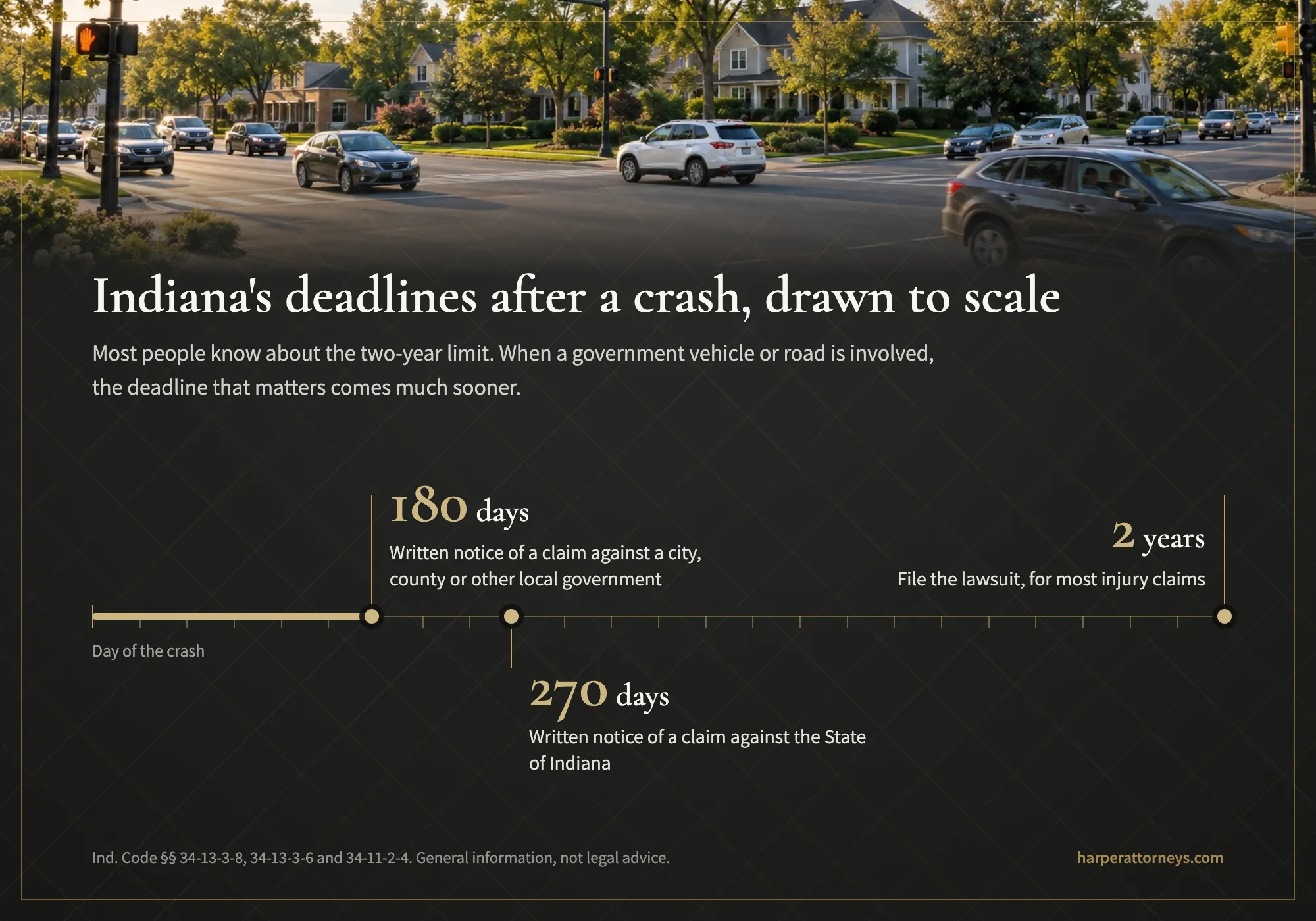
Two years for most injury claims. In most cases, an injury lawsuit must be filed within two years of the crash (Ind. Code § 34-11-2-4).
180 days if local government is involved. If a city or county vehicle, a snowplow, or a road defect played a role, written notice of your claim generally must be filed within 180 days (Ind. Code § 34-13-3-8). For claims against the State of Indiana, the deadline is 270 days (Ind. Code § 34-13-3-6). Government claims also follow a harsher fault rule, under which any fault on your part can bar recovery. Missing one of these notice deadlines can end a claim before the two-year clock ever matters.
Criminal cases don’t protect your civil claim. If the other driver may have been impaired, don’t wait for the criminal case to play out. Indiana’s average turnaround for toxicology results is 91 days for alcohol and 145 days for drugs (Indiana Triennial Highway Safety Plan FY2024–2026). Your civil claim needs its own investigation and its own timeline.
Talk to a Northwest Indiana injury lawyer early
You don’t need to have every answer the day of your crash. But the sooner someone starts preserving evidence and tracking deadlines, the more options you’ll have. If you’re unsure what to ask, start with our 15 Questions to Ask a Car Accident Lawyer in Indiana.
Harper & Harper represents people injured in car accidents and truck accidents throughout Porter, Lake, LaPorte, and Jasper Counties. Call 219-762-9538 or contact us online for a free consultation.
This page is general information about Indiana law, not legal advice, and past results never guarantee future outcomes. Reading it does not create an attorney-client relationship. (See our full disclaimer.)
Frequently Asked Questions
What should I do after a car accident in Indiana to protect my injury claim?
Call the police and get the crash report, get a medical evaluation right away even if you feel fine, follow your treatment plan and keep every bill, photograph the scene and collect witness contacts, talk with an attorney about saving your vehicle's black box data before the car is repaired, released, or scrapped, be careful what you say to insurers and online, check your own uninsured and underinsured motorist coverage, and track your deadlines. In Indiana most injury lawsuits must be filed within two years, but a claim involving a city or county requires written notice within 180 days.
How long do I have to file a car accident lawsuit in Indiana?
Generally two years from the crash under Ind. Code § 34-11-2-4. Shorter notice deadlines apply when government is involved: written notice within 180 days for a claim against a city, county, or other political subdivision (Ind. Code § 34-13-3-8), and within 270 days for a claim against the State of Indiana (Ind. Code § 34-13-3-6). Missing a notice deadline can bar the claim even though the two-year period has not run.
Who owns the black box data in my car after a crash in Indiana?
You do, if you own or lease the vehicle. The federal Driver Privacy Act of 2015 makes event data recorder data the property of the vehicle's owner or lessee, and others generally need your consent or a court order to retrieve it. Indiana has no separate black box statute. Ownership follows the vehicle, so once a totaled car's title is signed over to an insurer, control of the data goes with it.
Can I download my car's black box data myself?
Not practically. Federal rules require owner's manuals to state that special equipment is needed to read an event data recorder, and an ordinary code scanner cannot do it. The copy should be made by a trained, independent technician, ideally with the other side invited, so the data cannot later be challenged as mishandled. Your lawyer normally arranges this.
Can not wearing a seat belt reduce my compensation in Indiana?
It can, for crashes on or after July 1, 2024. Under Ind. Code § 9-19-10-7 as amended in 2024, a court may admit evidence that an injured person age 15 or older was not wearing a seat belt, but only on the question of reducing damages. Not wearing a belt still is not fault under Indiana's Comparative Fault Act, and the defendant must prove both that the belt was not worn and that wearing it would have reduced the injuries.
How long do trucking companies have to keep driver logs and inspection records?
Not long. Federal rules require motor carriers to keep drivers' hours-of-service records, including electronic logging device data, for only six months (49 C.F.R. § 395.8) and daily vehicle inspection reports for only three months (49 C.F.R. § 396.11). Heavy trucks also have no federally required crash recorder. Their crash data usually sits in the engine computer (the ECM), and that data and dashcam video can be replaced once the truck is back in service. A written preservation demand should go out as early as possible.
Should I give a recorded statement to the other driver's insurance company?
You are generally not required to, and it is wise to get legal advice first. Indiana reduces your compensation by your percentage of fault and bars recovery if you are more than 50% at fault (Ind. Code § 34-51-2-6), so offhand statements about what happened can be used to shift fault onto you.